Tennis elbow can turn everyday tasks, lifting a mug, typing, shaking hands, turning a doorknob, into sharp, frustrating pain on the outside of the elbow. If you’re searching for Tennis Elbow: Exercises and Physical Therapy That Work, you likely want two things: relief now and a plan that helps you heal without constantly re-aggravating the tendon.
This guide breaks down what tennis elbow is, why it lingers, and which tennis elbow exercises and physical therapy for tennis elbow approaches are most commonly recommended in evidence-informed care. You’ll learn how to calm symptoms, rebuild strength safely, and reduce your risk of recurrence, whether you’re an athlete, a desk worker, or someone who uses tools for work.
What Is Tennis Elbow (and Why Does It Hurt So Much)?
Tennis elbow, also called lateral epicondylitis, is irritation and degeneration of the tendon fibers where the forearm extensor muscles attach near the outside of the elbow. Despite the “-itis” name, it’s often less about acute inflammation and more about an overuse tendon problem that needs progressive loading and time to recover.
The pain is typically felt at or near the bony bump on the outside of the elbow and may radiate down the forearm. It often flares with gripping, lifting, wrist extension (bending the wrist back), and repetitive hand activities.
Common Causes and Triggers
- Repetitive gripping (tools, racquets, heavy bags, gardening)
- Typing/mousing with poor ergonomics or sustained tension
- Sudden increase in activity (new sport, more yard work, home projects)
- Poor load tolerance after a period of inactivity or prior injury
- Technique issues in racquet sports or occupational tasks
Typical Symptoms
- Pain or tenderness on the outside of the elbow
- Pain with gripping, shaking hands, opening jars, carrying groceries
- Weakness or discomfort when lifting with the palm facing down
- Morning stiffness or aching after activity
When to See a Professional (and When to Get Checked Right Away)
Many cases improve with a structured plan. Still, it’s wise to consult a clinician, especially if symptoms persist beyond a few weeks, you’re losing function, or you’re unsure what’s safe to do.
Seek prompt evaluation if you have:
- Significant swelling, redness, warmth, or fever
- Numbness/tingling in the hand or progressive weakness
- Neck/shoulder pain with radiating symptoms
- Locking, catching, or inability to fully move the elbow
- Severe pain after a sudden “pop” or trauma
Why Rest Alone Often Isn’t Enough
It’s natural to rest when something hurts, but tendons typically respond best to graded loading: the right amount of stress, progressed over time. Too much rest can lead to deconditioning, while too much activity can keep the tendon irritated. The goal is to find the “just right” dose of movement and strengthening.
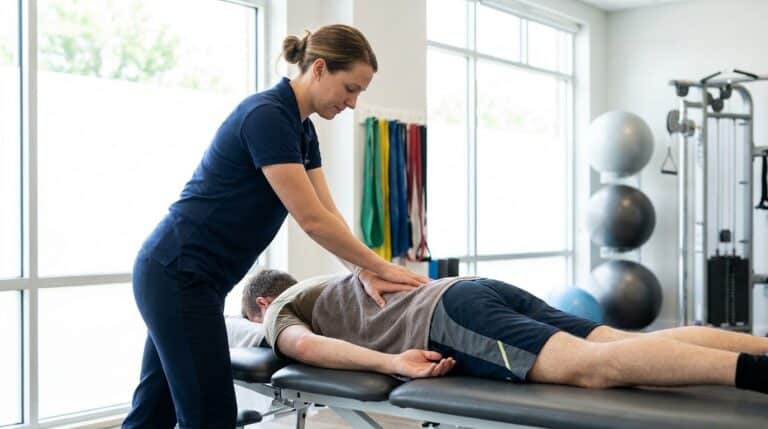
That’s where physical therapy for tennis elbow shines: it helps you identify aggravating factors, improve mechanics, and follow a progressive exercise plan that rebuilds capacity.
What Physical Therapy for Tennis Elbow Usually Includes
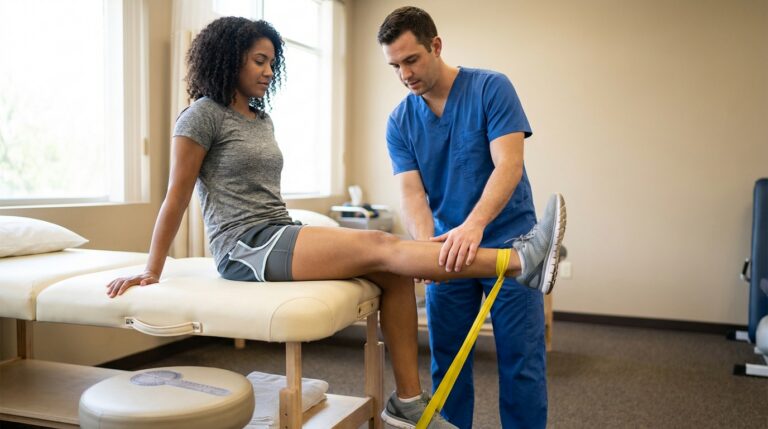
A well-rounded plan is more than a list of stretches. In most cases, physical therapy for tennis elbow combines symptom control, progressive strengthening, and practical changes to reduce repeated strain.
Key Components
- Assessment of contributing factors (wrist/forearm strength, shoulder stability, grip strategy, posture, work setup)
- Pain-modulating strategies (activity modification, bracing/taping, heat/ice guidance as appropriate)
- Progressive loading (isometrics, eccentrics, and heavier strengthening over time)
- Manual therapy (often used to reduce sensitivity and improve mobility)
- Return-to-activity planning for sport, work, and hobbies
How Long Does It Take to Improve?
Recovery varies. Many people notice meaningful improvement over weeks with consistent loading and better activity management. More stubborn cases can take longer, especially if the tendon has been irritated for months. The most reliable predictor of progress is usually consistency with an appropriate program, not pushing through sharp pain, and not doing nothing.
Tennis Elbow Exercises: A Step-by-Step Program
The best tennis elbow exercises are the ones you can do consistently with the right intensity. Use the guidelines below to choose a starting point and progress safely.
Before You Start: Pain Rules and Progression
- Acceptable discomfort: Mild to moderate discomfort during exercise is often okay if it settles shortly after and doesn’t worsen day-to-day.
- Avoid: Sharp pain, escalating pain that lingers, or next-day flare-ups that significantly reduce function.
- Progress slowly: Increase load first (weight/resistance), then volume (sets/reps), then speed.
- Consistency matters: Most strengthening works best done several times per week.
Phase 1: Calm Pain and Maintain Motion (Often 1–2 Weeks)
1) Wrist Extensor Isometrics (Pain-Reducing Strength)
How: Rest your forearm on a table with your wrist hanging off the edge, palm facing down. Use your other hand to resist as you gently try to lift the back of your hand upward (wrist extension) without moving.
- Hold: 20–45 seconds
- Sets: 3–5
- Effort: Moderate (about 5–7/10 effort)
Tip: If this increases pain, reduce effort or shorten the hold. Isometrics are often a good entry point when movement is sensitive.
2) Gentle Wrist Flexor/Extensor Range of Motion
How: With elbow bent at your side, slowly move your wrist up and down through a comfortable range.
- Reps: 10–15
- Sets: 1–3
3) Forearm Rotation (Supination/Pronation)
How: Keep elbow at your side, bent to 90 degrees. Rotate palm up and palm down slowly. Add a light object (like a small hammer) only if comfortable.
- Reps: 10–15
- Sets: 1–3
Phase 2: Build Tendon Capacity (Often 2–6+ Weeks)
This phase is the core of most successful plans. Progressive strengthening, especially controlled lowering, helps improve the tendon’s tolerance to load.
4) Eccentric Wrist Extension (Classic Tennis Elbow Strengthener)
How: Sit with forearm supported on a table, palm down, wrist over the edge. Hold a light dumbbell. Use your other hand to help lift the weight up (wrist extension). Then slowly lower the weight down over 3–5 seconds using the sore side.
- Reps: 8–12
- Sets: 2–4
- Frequency: 3–5 days/week
Progression: Increase weight gradually when you can complete all reps with controlled lowering and symptoms remain stable.
5) Concentric + Eccentric Wrist Extension (Full Strength)
How: Same setup as above, but lift and lower with the affected wrist without assistance (once tolerated).
- Reps: 8–12
- Sets: 2–4
6) Wrist Radial Deviation (Often Overlooked)
How: Thumb up position (like a handshake). Move your wrist so the thumb side lifts toward the ceiling. Use a light weight.
- Reps: 10–15
- Sets: 2–3
7) Grip Strengthening (Dose It Carefully)
How: Use a soft ball or putty. Squeeze gently and hold, avoiding sharp pain at the elbow.
- Hold: 3–5 seconds
- Reps: 10–15
- Sets: 2–3
Tip: Overdoing grip work can flare symptoms. Start lighter than you think and increase slowly.
8) Finger Extension (Balance the Forearm)
How: Place a rubber band around your fingers and thumb. Open your hand against the band’s resistance.
- Reps: 15–25
- Sets: 2–3
See a Thrive clinician
Acupuncture, dry needling and physical therapy across four Long Island offices. Same-week appointments are usually available, and you do not need a referral to start.
Phase 3: Return to Sport/Work Demands (Strength + Endurance + Control)
Once daily tasks are easier and strengthening is tolerated, the next step is preparing for real-life load: longer durations, faster movements, and more complex tasks.
9) Heavier Slow Resistance (Wrist/Forearm)
How: Continue wrist extension and radial deviation with heavier weight at slower tempo (2–3 seconds up, 2–3 seconds down).
- Reps: 6–10
- Sets: 3–5
- Frequency: 2–3 days/week
10) Functional Lifting Practice
How: Practice lifting light objects with a neutral wrist (not bent back), keeping the load close to your body. Gradually increase weight and duration.
11) Shoulder and Upper Back Strength (Often a Missing Link)
Improving shoulder and scapular control can reduce overload on the forearm during gripping and reaching.
- Rows (band or cable): 2–4 sets of 8–12
- External rotation (band): 2–3 sets of 10–15
- Scapular retraction holds: 3–5 holds of 10–20 seconds
Stretching for Tennis Elbow: Helpful or Hype?
Stretching can help some people feel looser and reduce sensitivity, but it usually works best as a supplement, not the main treatment. If stretching increases pain, it may be too aggressive for your current irritability level.
Wrist Extensor Stretch (Gentle Version)
How: Elbow straight, palm down. Use the other hand to gently bend the wrist down and slightly toward the pinky side until you feel a mild stretch in the outer forearm.
- Hold: 15–30 seconds
- Repeats: 2–4
Activity Modification That Actually Helps
You don’t have to stop using your arm entirely, but you may need temporary changes while you build capacity.
Reduce the Biggest Provokers (Temporarily)
- Avoid repeated heavy gripping and twisting (e.g., wringing towels, heavy screwdriver use)
- Limit lifting with palm down; try palm up or neutral grip when possible
- Break up long sessions into smaller blocks with short rests
Ergonomics for Desk Work
- Keep mouse close; avoid reaching
- Use a relaxed grip on the mouse
- Consider alternating hands or using a different mouse style if gripping is high
- Keep wrists neutral rather than extended
Bracing: Does a Tennis Elbow Strap Work?
A counterforce strap worn around the forearm can reduce strain on the tendon for some people during activity. It is not a fix, but it may help you tolerate work or sport while you strengthen. If it increases symptoms or causes numbness, stop and get guidance.
What to Expect at Thrive Health (and How PT Is Individualized)
At Thrive Health, a typical plan for tennis elbow focuses on matching the right exercises to your irritability level, then progressing load in a way that fits your job, sport, and daily demands. Many programs also address shoulder and upper back strength, grip strategy, and movement habits that can keep the tendon overloaded.
If you’re also exploring complementary approaches, Thrive Health Acupuncture may be used as part of a broader plan to help manage pain and improve tolerance to rehab, especially when symptoms are highly reactive. The cornerstone, however, is usually progressive strengthening and practical activity modification.
Care may be available across East Setauket, Sayville, Smithtown, and Westhampton, depending on your needs and scheduling.
Common Mistakes That Slow Recovery
- Doing only stretching and skipping strengthening
- Resting completely for long periods, then returning to full activity suddenly
- Pushing through sharp pain during gripping or lifting
- Using weights that are too heavy too soon
- Ignoring shoulder and posture factors that increase forearm load
Sample Weekly Plan (Adjust to Your Symptoms)
| Day | Focus | Example |
|---|---|---|
| Mon | Strength | Eccentric wrist extension, grip isometrics, rows |
| Tue | Light mobility | Wrist ROM, forearm rotation, gentle stretch |
| Wed | Strength | Wrist extension (full), radial deviation, external rotation |
| Thu | Active recovery | Shorter isometrics, mobility, easy functional lifting practice |
| Fri | Strength | Heavier slow resistance, grip work (light), rows |
| Sat | Gradual return | Sport/work task exposure at reduced volume |
| Sun | Rest/reset | Gentle mobility, plan next week’s progression |
How to Know Your Exercises Are Working
Look for functional improvements, not just pain scores. Signs you’re on the right track include:
- Less pain with daily tasks (lifting, gripping, typing)
- Improved strength and endurance in the forearm
- Flares become smaller and resolve faster
- You can increase resistance gradually without symptom spikes
Practical benchmark: If symptoms are slowly trending better week-to-week and your capacity is increasing, your program is likely appropriately dosed.
Practical benchmark: If symptoms are slowly trending better week-to-week and your capacity is increasing, your program is likely appropriately dosed.
FAQ: Tennis Elbow Exercises and Physical Therapy
1) What are the best tennis elbow exercises to start with if everything hurts?
Start with wrist extensor isometrics (gentle resisted holds) and comfortable range-of-motion work. These options often reduce sensitivity while maintaining strength without excessive tendon irritation. If even light holds are painful, a clinician can help adjust positioning and load.
2) How often should I do tennis elbow exercises?
Many people do best with strengthening 3–5 days per week early on, then transitioning to 2–3 days per week for heavier strengthening as tolerance improves. Mobility can be done more frequently if it doesn’t aggravate symptoms.
3) What does physical therapy for tennis elbow do that I can’t do on my own?
Physical therapy for tennis elbow helps you identify the true drivers of overload (work technique, grip strategy, shoulder weakness, training errors), choose the right starting loads, and progress safely. It also provides hands-on options and individual return-to-sport or return-to-work planning.
4) Should I stop all activity until it heals?
Usually, no. Complete rest can reduce capacity and make the tendon more sensitive when you return to normal use. A better approach is temporary modification of painful tasks while following a progressive strengthening plan.
5) Is stretching enough to fix tennis elbow?
Stretching may help with comfort, but it’s rarely sufficient alone. Most lasting improvement comes from progressive strengthening (often including eccentrics and heavier slow resistance) and reducing repetitive overload during recovery.
6) Do braces or straps fix tennis elbow?
Braces and counterforce straps do not resolve the condition, but they can reduce symptoms during activity for some people. They’re best used as a temporary aid while you build tendon capacity with tennis elbow exercises and a structured rehab plan.
7) When should I consider seeing Thrive Health?
Consider an evaluation if pain persists beyond a few weeks, you’re struggling to progress exercises without flare-ups, or your work/sport demands require a faster, more structured return plan. Thrive Health can adjust physical therapy for tennis elbow to your irritability level and goals, with care options across East Setauket, Sayville, Smithtown, and Westhampton.