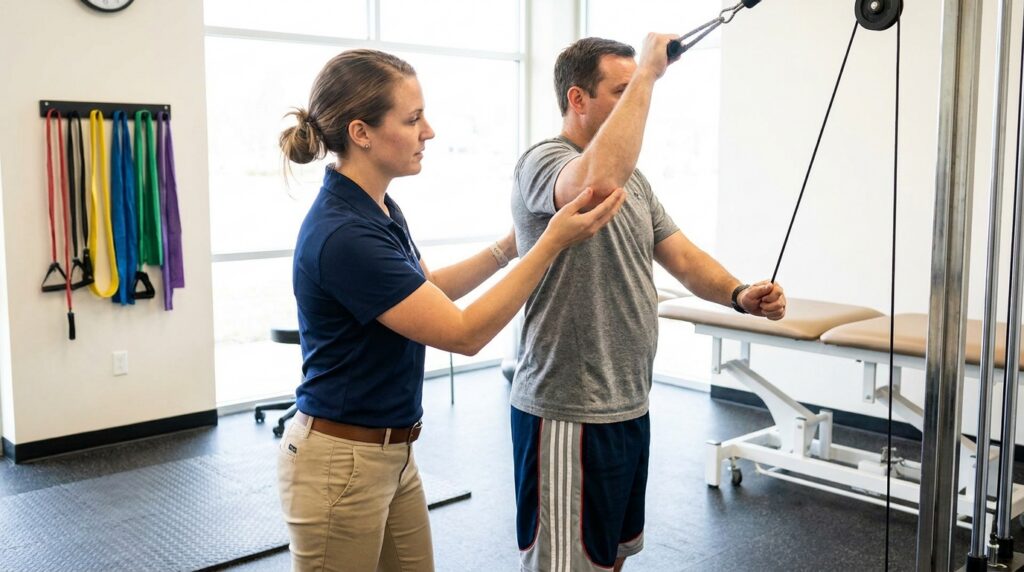
After rotator cuff surgery, most people want the same things: less pain, a clear plan, and a realistic sense of how long recovery will take. The good news is that physical therapy after rotator cuff surgery follows a structured progression designed to protect the repair early on and then steadily rebuild mobility, strength, and confidence. The challenging part is that healing isn’t instant, tendons need time to reattach and mature, and pushing too hard too soon can set you back.
This guide walks you through a typical Physical Therapy After Rotator Cuff Surgery: Recovery Timeline, what to expect at each phase, and how to make the most of rehab. Keep in mind that your surgeon’s protocol and your therapist’s guidance always come first, because tear size, tissue quality, surgical technique, and your overall health can change the plan.
Understanding the Rotator Cuff and Why Rehab Is So Structured
The rotator cuff is a group of muscles and tendons that stabilize the shoulder and help you lift and rotate your arm. Surgery usually repairs a torn tendon back to the bone. Early in recovery, the repair site is vulnerable to stress from lifting, reaching, or sudden movements. That’s why protection is the priority at first, even if you feel “okay.”
As healing progresses, rehab gradually shifts toward restoring:
- Range of motion (getting your shoulder moving again safely)
- Strength and endurance (especially rotator cuff and shoulder blade muscles)
- Control and mechanics (how your shoulder moves during daily tasks)
- Function (work, sports, hobbies, and overhead activity)
Physical Therapy After Rotator Cuff Surgery: Recovery Timeline (Typical Phases)
Below is a common timeline used in many post-operative protocols. Your actual plan may move faster or slower depending on your surgeon’s instructions, pain levels, stiffness, and how your shoulder responds to each step. When in doubt, prioritize tissue healing and quality movement over speed.
Phase 1: Protection and Early Healing (Weeks 0–4)
Main goals: protect the repair, manage pain and swelling, prevent stiffness in surrounding joints, and maintain gentle shoulder mobility as allowed.
What you may experience:
- Wearing a sling most of the day (often with an abduction pillow)
- Sleeping discomfort and difficulty finding a comfortable position
- Limited use of the surgical arm for daily activities
Typical physical therapy focus:
- Education on sling use, safe positions, and movement precautions
- Pain management strategies (ice, positioning, gentle soft tissue work when appropriate)
- Passive range of motion (your therapist moves the shoulder, if cleared)
- Gentle mobility for neck, elbow, wrist, and hand to avoid stiffness
- Scapular (shoulder blade) awareness and light activation without stressing the repair
Common precautions: Avoid lifting, pushing, pulling, reaching behind your back, sudden movements, and active shoulder lifting unless specifically cleared.
Phase 2: Early Motion and Controlled Mobility (Weeks 4–8)
Main goals: gradually restore shoulder motion while continuing to protect the tendon repair.
What you may experience:
- Transitioning out of the sling (timing varies)
- Stiffness and “tightness” as you start moving more
- Improving comfort with basic daily tasks, still with restrictions
Typical physical therapy focus:
- Progressive passive range of motion and gentle stretching as tolerated
- Active-assisted range of motion (you help the arm move using the other arm, a cane, or pulleys if approved)
- Posture and shoulder blade control to support healthy mechanics
- Gentle isometrics (muscle activation without moving the shoulder) if cleared by your surgeon
What “good progress” looks like: steady improvements in motion week to week with manageable soreness that settles within 24 hours. Sharp pain, increasing night pain, or a sudden loss of function should be reported promptly.
Phase 3: Active Motion and Early Strengthening (Weeks 8–12)
Main goals: regain active control of the shoulder, build foundational strength, and normalize movement patterns.
What you may experience:
- Less pain at rest, but fatigue or soreness after therapy
- Difficulty with overhead reach or reaching behind your back
- Improving confidence using the arm for light activities
Typical physical therapy focus:
- Active range of motion (you move the arm under your own control)
- Rotator cuff and scapular strengthening using light resistance (bands, small weights)
- Motor control training to reduce compensations like shrugging
- Functional training for daily activities (reaching, carrying light objects)
Key point: This phase often feels like you’re “behind” because strength returns slower than motion. That’s normal. Tendons and muscles need time to tolerate load again.
Phase 4: Progressive Strength, Endurance, and Function (Months 3–6)
Main goals: restore strength and endurance for work and daily life, improve overhead tolerance, and rebuild shoulder capacity.
What you may experience:
- Significant functional improvements
- Occasional soreness after new exercises or heavier activity
- More confidence reaching overhead, lifting, and returning to hobbies
Typical physical therapy focus:
- Progressive resistance training for rotator cuff, deltoid, and scapular stabilizers
- Endurance work (higher repetitions, longer time under tension)
- Mobility refinement (especially behind-the-back reach and overhead mechanics)
- Task-specific training based on your goals (job demands, home tasks, recreational activities)
Practical milestone: Many people can resume a wider range of normal activities during this period, but heavy lifting and repetitive overhead work may still be limited depending on your surgeon’s guidance and your strength levels.
Phase 5: Return to Higher-Level Activity (Months 6–12)
Main goals: maximize strength, power, and control; return to sport or physically demanding work when appropriate.
What you may experience:
- Near-normal daily function
- Remaining weakness with sustained overhead activity
- Occasional stiffness, especially after inactivity
Typical physical therapy focus:
- Advanced strengthening and higher-load tolerance (as cleared)
- Plyometric or dynamic stability drills for athletes (when appropriate)
- Work conditioning for jobs requiring lifting, carrying, climbing, or overhead tasks
- Maintenance programming to protect long-term shoulder health
When people ask about rotator cuff recovery time, this is the key takeaway: many feel “pretty good” by 3–6 months, but full capacity, especially for overhead strength and endurance, often takes longer.
See a Thrive clinician
Acupuncture, dry needling and physical therapy across four Long Island offices. Same-week appointments are usually available, and you do not need a referral to start.
What Affects Rotator Cuff Recovery Time?
Even with excellent rehab, recovery varies. Common factors that influence rotator cuff recovery time include:
- Tear size and chronicity: larger or long-standing tears may require a more conservative progression.
- Tissue quality: tendon and bone quality can affect healing and tolerance to loading.
- Surgical details: additional procedures (like biceps work) may add precautions.
- Stiffness history: some shoulders tighten quickly and need extra mobility work.
- Overall health: sleep, nutrition, metabolic health, and smoking status can influence healing.
- Consistency with rehab: regular therapy and an appropriate home program matter.
What to Expect in Physical Therapy After Rotator Cuff Surgery
While protocols differ, most rehab plans include a blend of hands-on care (when appropriate), guided exercise, and education. Your therapist will typically monitor:
- Pain response during and after sessions
- Range of motion (passive and active)
- Strength and endurance progression
- Movement quality (avoiding compensations that overload the neck or upper trap)
- Functional milestones relevant to your life
In many cases, the most important work happens between visits: a simple, consistent home routine performed with the right technique and intensity.
Common Milestones (General Guide)
Milestones vary, but the following are common checkpoints people ask about:
- Sleeping more comfortably: often improves gradually over the first 4–8 weeks.
- Driving: commonly allowed once you are off strong pain medication, have adequate control, and your surgeon clears you (often after sling use ends).
- Typing/desk work: may resume earlier with modifications, depending on pain and sling requirements.
- Reaching overhead: usually improves meaningfully after active motion and strengthening begin (often 8–16 weeks).
- Lifting: starts light and progresses slowly; heavier lifting is typically later in rehab.
- Sports: timing depends on the sport; overhead and contact sports generally require longer build-up.
How to Know If You’re Progressing Appropriately
Some soreness is normal when you begin new movements or strengthening. Signs that your rehab intensity is generally appropriate include:
- Soreness that feels muscular rather than sharp or “pinching”
- Symptoms that settle within about a day after exercise
- Gradual improvements in motion, control, and tolerance to daily tasks
Contact your surgeon or therapist if you notice:
- Sudden increase in pain that doesn’t settle
- New weakness or inability to lift the arm compared to prior days
- Significant swelling, redness, fever, or concerning wound changes
- Persistent night pain that worsens over time
Tips to Get the Most Out of Physical Therapy After Rotator Cuff Surgery
1) Respect the Sling and Early Restrictions
Early protection is not “wasted time.” It’s the foundation that allows strengthening later. If you overload the repair too soon, you can create inflammation, setbacks, or complications.
2) Prioritize Quality of Movement Over Quantity
Ten controlled repetitions with good shoulder blade mechanics are often more valuable than thirty rushed reps with compensations.
3) Use Pain as a Guide. But Not the Only Guide
Pain levels can fluctuate due to sleep, stress, and activity. Follow the plan and communicate patterns to your therapist so they can adjust dosage and exercise selection.
4) Be Consistent With Your Home Program
Rehab works best when the home program is simple, repeatable, and progressed at the right time. If you’re unsure about an exercise, ask for a form check.
5) Don’t Skip Scapular and Posture Work
Shoulder blade control helps distribute load and can reduce strain on the healing tendon. This becomes increasingly important as you return to overhead activity.
Table: Rotator Cuff Surgery Rehab Timeline at a Glance
| Phase | Approx. Timeframe | Main Focus | Typical Activities |
|---|---|---|---|
| Protection | 0–4 weeks | Protect repair, manage pain | Passive motion (if cleared), hand/elbow/wrist mobility, education |
| Controlled Mobility | 4–8 weeks | Restore motion safely | Passive to active-assisted ROM, gentle activation (if cleared) |
| Active Motion + Early Strength | 8–12 weeks | Control and foundational strength | Active ROM, light resistance, movement retraining |
| Strength + Function | 3–6 months | Build capacity for life/work | Progressive loading, endurance, task-specific training |
| Higher-Level Return | 6–12 months | Max strength and performance | Advanced strengthening, sport/work conditioning, maintenance |
Common Concerns: Pain, Stiffness, and Fear of Re-Injury
Pain: What’s Normal?
It’s common to have pain early on, especially at night. As you move through physical therapy after rotator cuff surgery, you may notice soreness after sessions or new exercises. In general, your plan should aim to keep symptoms manageable and trending in the right direction over weeks.
Stiffness: Will I Get My Motion Back?
Many people regain excellent motion, but the pace can be slow, especially for behind-the-back reach and overhead flexibility. Your therapist will balance stretching and mobility work with protection of the repair. If you’re prone to stiffness, your plan may emphasize mobility a bit more (without becoming aggressive too early).
Fear of Re-Tearing: How Do I Move Confidently?
Confidence usually returns as your shoulder demonstrates reliability: you can lift your arm without compensating, tolerate light loads, and recover well after activity. A well-paced strengthening program is often the best antidote to fear, because it provides objective proof that your shoulder can handle more.
When Can You Return to Work and Sports?
Return-to-activity decisions should be individualized and cleared by your surgeon. In general:
- Desk work: may return relatively early with ergonomic adjustments and sling considerations.
- Light-duty work: often becomes possible as active motion improves and restrictions ease.
- Manual labor: commonly requires later-stage strengthening and work conditioning.
- Non-overhead sports: may return sooner than overhead or contact sports.
- Overhead sports: often require the longest runway due to high tendon load and endurance demands.
If your goal is to return to demanding overhead tasks, expect rotator cuff recovery time to be closer to the longer end of the spectrum, with progressive loading and mechanics work guiding the final stages.
FAQ: Physical Therapy After Rotator Cuff Surgery
1) How long is physical therapy after rotator cuff surgery?
Many rehab plans span 3 to 6 months of structured progression, with some people continuing longer for higher-level goals. The exact duration depends on tear size, healing response, and whether you’re returning to heavy work or overhead sports.
2) What is the typical rotator cuff recovery time for normal daily activities?
Many people regain comfortable function for basic daily tasks within a few months, but overhead strength and endurance can take longer. For many, rotator cuff recovery time for near-normal daily life falls in the 3–6 month range, while full capacity may take up to a year.
3) When can I start strengthening in physical therapy after rotator cuff surgery?
Strengthening typically begins after a period of protection and motion work, often around 8–12 weeks, but timing varies. Your surgeon’s protocol determines when the tendon is ready for increased loading.
4) Is it normal for my shoulder to feel stiff during recovery?
Yes. Stiffness is common, especially as you transition out of the sling and begin moving more. Your therapist will progressively restore mobility while keeping the repair protected.
5) What should I avoid during the early recovery timeline?
Common early restrictions include lifting, pushing, pulling, sudden reaching, and reaching behind your back. Avoid any movement your surgeon or therapist has not cleared, even if pain is low.
6) How often should I do my home exercises?
Your therapist will prescribe a frequency based on your phase of healing. Early on, exercises are often short and gentle but consistent. Later, strengthening days may alternate to allow recovery. If soreness persists beyond a day, your program may need adjustment.
7) What if I feel a sharp pain during an exercise?
Stop the exercise and let your therapist know. Sharp pain, catching, or a sudden increase in symptoms may signal that the movement is too aggressive for your current stage or needs form correction.