After a knee replacement, most people want the same things: less pain, better mobility, and a clear plan for getting back to daily life. That’s exactly where physical therapy after knee replacement comes in. Rehab isn’t just “a few exercises”. It’s a structured process that helps you regain range of motion, rebuild strength, improve balance, and relearn safe movement patterns so your new joint can perform its best.
This guide lays out a practical, week-by-week Physical Therapy After Knee Replacement: A Recovery Timeline. Keep in mind that timelines vary based on your overall health, whether you had a partial or total knee replacement, your pre-surgery strength and mobility, and your surgeon’s specific precautions. Always follow your surgeon and physical therapist’s instructions first, then use this timeline as a roadmap for what’s commonly expected.
Important: The exercises and milestones below are educational and must be matched to your specific procedure and medical guidance. Stop and contact your care team if you develop fever, worsening redness/heat at the incision, calf pain, sudden swelling, shortness of breath, or sharp/worsening pain that doesn’t improve with rest.
Important: The exercises and milestones below are educational and must be matched to your specific procedure and medical guidance. Stop and contact your care team if you develop fever, worsening redness/heat at the incision, calf pain, sudden swelling, shortness of breath, or sharp/worsening pain that doesn’t improve with rest.
Why Physical Therapy Matters After Knee Replacement
Knee replacement surgery changes the mechanics of your joint, but it doesn’t automatically restore strength, mobility, or confidence. Physical therapy after knee replacement helps you:
- Restore range of motion (ROM): bending (flexion) and straightening (extension) are key for walking, stairs, and sitting comfortably.
- Reduce swelling and stiffness: movement, leg-raising strategies, and gentle muscle activation can support circulation and comfort.
- Rebuild strength: especially in the quadriceps, glutes, hamstrings, and calves.
- Improve gait: correcting limping early can reduce stress on your hip, back, and other knee.
- Enhance balance and stability: to prevent falls and increase confidence.
- Support return to function: from getting out of a chair to returning to work, hobbies, and fitness.
What to Expect from Your Rehab Plan
Rehab typically progresses through overlapping phases. Your physical therapist will adjust based on pain, swelling, incision healing, ROM, strength, and how you tolerate activity.
Common Elements of Physical Therapy After Knee Replacement
- Pain and swelling management: positioning, gentle movement, and activity pacing.
- Range-of-motion training: focusing on both bending and full straightening.
- Strength training: starting with muscle activation and progressing to functional strengthening.
- Gait training: safe use of walker/cane and improving step pattern.
- Functional training: transfers, stairs, getting in/out of car, and daily tasks.
- Home exercise program: consistent practice is often the biggest driver of progress.
Physical Therapy After Knee Replacement: A Recovery Timeline
Below is a detailed timeline that reflects typical milestones. Your therapist may move you faster or slower depending on your presentation.
Phase 1: Days 0–7 (Week 1). Protect, Reduce Swelling, Start Moving
The first week is about safe mobility and building a foundation. You’ll likely begin moving the knee very soon after surgery, often the same day or next day, depending on your care plan.
Main Goals
- Control swelling and discomfort with positioning and gentle activity.
- Begin walking safely with an assistive device (often a walker).
- Start gentle ROM and muscle activation.
- Practice basic function: bed mobility, transfers, bathroom safety.
What Physical Therapy Often Focuses On
- Extension (straightening): achieving a straight knee is crucial for efficient walking.
- Gentle flexion (bending): gradual progress without forcing.
- Quad activation: waking up the thigh muscle to stabilize the knee.
- Gait mechanics: heel-to-toe pattern as tolerated.
Early Knee Replacement Recovery Exercises (Common Examples)
- Ankle pumps to encourage circulation.
- Quad sets (tighten thigh with the knee straight).
- Glute squeezes to support hip stability.
- Heel slides (gentle bending while lying down).
- Straightening practice with the leg supported (as instructed).
Tip: Swelling can limit motion. Consistent short bouts of movement throughout the day often work better than pushing hard once.
Phase 2: Weeks 2–3. Improve ROM, Transition Mobility, Build Routine
During weeks 2–3, many people begin feeling more “human” again, still sore and swollen at times, but increasingly capable. Your therapist will likely work on improving walking quality and increasing knee motion.
Main Goals
- Increase knee bending and maintain full extension (your therapist will set individualized targets).
- Improve walking endurance and reduce reliance on the walker as appropriate.
- Begin more structured strengthening while respecting healing tissues.
- Normalize daily activities like getting in/out of chairs and bed with less assistance.
Physical Therapy Priorities
- Gait training: reducing limping, improving stride length, and timing.
- Scar and soft tissue management: only when cleared and appropriate.
- Balance basics: safe weight shifting and supported single-leg loading.
Knee Replacement Recovery Exercises (Common Examples)
- Seated knee bends (gentle flexion holds).
- Short arc quads (small-range knee straightening).
- Standing hip abduction (strengthen lateral hip for stability).
- Mini squats to a comfortable depth (as tolerated).
- Step-ups on a low step (when approved).
Tip: It’s normal to feel more sore after therapy sessions. The goal is “worked” and slightly achy, not sharply painful or significantly worse the next day.
Phase 3: Weeks 4–6. Strength and Function Take the Lead
By weeks 4–6, rehab often shifts from “getting motion back” to “using motion well.” Many people transition from walker to cane and then to walking without a device, depending on gait quality and safety.
Main Goals
- Improve functional strength for stairs, sit-to-stand, and longer walks.
- Increase endurance while managing swelling.
- Refine balance and stability for uneven surfaces and turns.
- Continue ROM gains and reduce stiffness.
What PT Sessions Often Include
- Progressive resistance exercises for quads, glutes, hamstrings, and calves.
- Functional training: controlled squats, step work, and safe stair strategies.
- Stationary cycling (often used to support motion and endurance once comfortable).
- Gait refinement: improving cadence, symmetry, and confidence.
Knee Replacement Recovery Exercises (Common Examples)
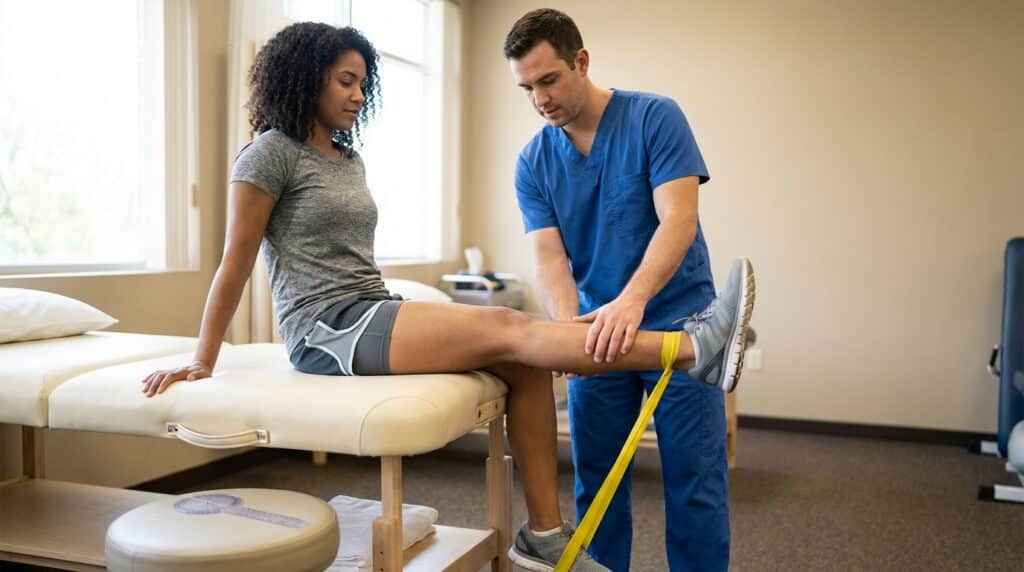
- Standing terminal knee extensions (band-assisted, if appropriate).
- Leg press (light to moderate) under supervision when cleared.
- Step-downs (eccentric control for stairs).
- Calf raises for push-off strength.
- Single-leg balance drills with support as needed.
Tip: If swelling spikes after activity, consider reducing volume (sets/reps/steps) and spacing activity more evenly through the day.
See a Thrive clinician
Acupuncture, dry needling and physical therapy across four Long Island offices. Same-week appointments are usually available, and you do not need a referral to start.
Phase 4: Weeks 7–12. Build Capacity for “Real Life”
This phase is where many people feel meaningful improvements in day-to-day function. You may be walking longer distances, managing stairs more confidently, and returning to more normal routines.
Main Goals
- Increase strength and power for higher-demand tasks.
- Improve movement quality (squatting, stepping, carrying, turning).
- Enhance balance and coordination to reduce fall risk.
- Return to low-impact fitness as cleared (walking programs, cycling, pool exercise).
What to Expect in Therapy
- Higher-level strengthening: deeper sit-to-stands, more challenging step patterns.
- Endurance progression: structured walking or cycling intervals.
- Mobility work: addressing stiffness in the knee, hip, and ankle that can affect mechanics.
Knee Replacement Recovery Exercises (Common Examples)
- Loaded sit-to-stand (adding light resistance when ready).
- Split-stance work (supported lunging patterns if appropriate).
- Side-stepping with resistance band (hip and knee control).
- Longer step-ups and controlled stair practice.
Phase 5: Months 3–6. Return to Activities and Long-Term Strength
At 3–6 months, many people are back to a wide range of daily activities with improved comfort. You’ll likely still notice occasional stiffness, especially after sitting, in the morning, or after a busy day. Continued strengthening and regular movement often make the biggest difference in how the knee feels over time.
Main Goals
- Build long-term leg strength and muscular endurance.
- Increase confidence with community mobility (curbs, uneven ground, longer outings).
- Return to desired hobbies (typically low-impact activities, depending on medical guidance).
- Maintain mobility so stiffness doesn’t creep back in.
Common Training Focus
- Progressive resistance (heavier loads with excellent form, if cleared).
- Functional conditioning (carry, step, squat patterns that match your goals).
- Balance and agility basics (safe direction changes, controlled pivots).
Phase 6: Months 6–12. Maximize Outcomes and Keep Gains
Recovery can continue for up to a year as strength, coordination, and tissue tolerance improve. Many people find that the knee feels more “natural” over time, especially when they stay consistent with a simple maintenance plan.
Long-Term Goals
- Maintain strength and healthy body mechanics to protect the joint and surrounding tissues.
- Stay active with low-impact exercise (as recommended).
- Prevent setbacks by addressing small issues early (swelling, gait changes, new pain).
Milestones at a Glance (Typical, Not Promised)
| Timeframe | Primary Focus | Common Signs of Progress |
|---|---|---|
| Week 1 | Swelling control, safe walking, gentle ROM | Short walks with device, improving transfers, basic exercises tolerated |
| Weeks 2–3 | Increase ROM, improve gait, start strengthening | More comfortable walking, better bend/straighten, less assistance needed |
| Weeks 4–6 | Functional strength, endurance, gait quality | Longer walks, stairs improving, transition toward cane/no device (as safe) |
| Weeks 7–12 | Capacity for daily life, balance, low-impact fitness | More normal routine, better stamina, improved control with steps/squats |
| Months 3–6 | Return to activities, long-term strengthening | Less stiffness, better confidence, higher activity tolerance |
| Months 6–12 | Maximize outcomes, maintain gains | More natural movement, stable strength, consistent function |
Common Questions and Concerns During Knee Replacement Rehab
How Much Pain Is Normal?
Some discomfort is expected, especially with exercise and increased activity. In general, pain that improves with rest, raising the limb, and recovery strategies is more typical than pain that escalates daily or feels sharp and alarming. Your therapist can help you distinguish normal post-exercise soreness from signs you’re doing too much.
Why Is Swelling Still There?
Swelling can persist for weeks to months and often increases with activity. Swelling is one of the biggest reasons the knee feels stiff or hard to bend. A well-paced plan for physical therapy after knee replacement usually balances strengthening with recovery so swelling doesn’t become the limiting factor.
Is It Better to Push Hard to Regain Motion?
Consistency typically beats intensity. Gentle, frequent motion and progressive strengthening often work better than forcing the knee into painful ranges. Your therapist will help you challenge the knee appropriately without provoking excessive inflammation.
When Can I Walk Without a Cane or Walker?
This depends on your safety and gait quality. Many people can reduce device use over the first several weeks, but the “right” time is when you can walk without significant limping and without increased pain or instability. Walking without a device too early can reinforce poor mechanics.
When Can I Do Stairs Normally?
Stairs require strength and control, especially when going down. Early on, many people use a step-to pattern (one step at a time). As quadriceps strength improves, you’ll progress toward a more natural alternating pattern.
Tips to Get the Most Out of Physical Therapy After Knee Replacement
- Do your home program: The best knee replacement recovery exercises are the ones you do consistently with good form.
- Prioritize extension: A knee that won’t fully straighten can affect walking, standing, and overall comfort.
- Track swelling patterns: If swelling spikes after specific activities, adjust volume and build gradually.
- Focus on gait quality: Slow down and walk well rather than fast with a limp.
- Strengthen the hips: Strong glutes help align the leg and reduce stress at the knee.
- Communicate: Tell your therapist what feels stuck, stairs, sleep, bending, fear of falling, so treatment matches your goals.
When to Call Your Surgeon or Therapist
Contact your medical team promptly if you notice:
- Increasing redness, warmth, drainage, or foul odor at the incision site
- Fever or chills
- New or worsening calf pain, significant swelling, or tenderness
- Sudden shortness of breath or chest pain
- Rapid loss of function or pain that escalates and doesn’t settle with rest
How Thrive Health Supports Knee Replacement Recovery
A structured plan, clear milestones, and coaching through the ups and downs can make rehab feel far more manageable. At Thrive Health, physical therapists commonly focus on restoring motion, rebuilding strength, improving walking mechanics, and progressing you through knee replacement recovery exercises that match your goals and your stage of healing. If you’re also exploring supportive services, Thrive Health Acupuncture may be discussed as part of a broader comfort and recovery strategy when appropriate and medically cleared.
Care is available across East Setauket, Sayville, Smithtown, and Westhampton, with treatment plans individualized to your surgeon’s protocol, your lifestyle needs, and your progress over time.
FAQ: Physical Therapy After Knee Replacement
1) How long do I need physical therapy after knee replacement?
Many people participate in formal therapy for several weeks, with continued independent exercise afterward. The exact duration depends on your ROM, strength, walking pattern, swelling, and functional goals. Your therapist will typically taper visits as you become more independent and consistent with your home program.
2) How often should I do knee replacement recovery exercises at home?
Most home programs emphasize frequent, short sessions, especially early on, rather than one long workout. Your therapist will prescribe a schedule based on your swelling, pain levels, and current phase of recovery.
3) What is the most important motion to regain, bending or straightening?
Both matter, but full straightening (extension) is often prioritized early because it strongly affects walking mechanics and standing comfort. Bending typically improves steadily with consistent practice and reduced swelling.
4) Is it normal to feel stiff at night or after sitting?
Yes. Stiffness after inactivity is common for months. Gentle movement, short walks, and consistent strengthening often reduce this over time. If stiffness is worsening rather than gradually improving, discuss it with your therapist.
5) When can I return to driving after knee replacement?
This varies based on which leg was operated on, your reaction time, medication use, and your surgeon’s clearance. Many people need several weeks before driving is considered safe. Always follow your surgeon’s guidance.
6) Can I overdo it during physical therapy after knee replacement?
Yes. Doing too much too soon can increase swelling and pain, which may temporarily limit ROM and slow progress. A good plan challenges you while keeping symptoms manageable and trending in the right direction week to week.
7) What if my progress feels slower than the timeline?
Timelines are averages, not rules. Swelling, sleep, other joint issues, and pre-surgery strength all influence pace. Let your therapist know what feels stuck, often a small change in exercise selection, volume, or recovery habits can help you move forward safely.