Last fall, a Stony Brook University graduate student visited our office in East Setauket, Sayville, Smithtown, and Westhampton with a familiar pattern. She had been writing her dissertation for eleven hours a day, clenching through the work, and waking around 4 a.m. with her jaw stuck. Her dentist had provided a night guard. Her primary care doctor recommended ibuprofen and “stress management.” Neither made a meaningful difference. On the morning of her first visit, she couldn’t open her mouth wide enough to take a bite of breakfast.
After two sessions focused on acupuncture for TMJ dysfunction, she was eating normally again. After six sessions of targeted acupuncture for TMJ care, her nighttime clenching had decreased by roughly seventy percent.
Cases like this are common at Thrive Health Acupuncture because temporomandibular disorders often sit where needling tends to help most: significant musculoskeletal pain combined with a strong stress and nervous-system component. This guide summarizes the 2024–2026 research, the current understanding of jaw dysfunction physiology, and the blended traditional acupuncture and dry needling strategy used with patients across East Setauket, Sayville, Smithtown, and Westhampton who choose acupuncture for TMJ symptom support.
Main Points at a Glance
- How common it is: TMJ disorders (TMDs) affect an estimated 11–12 million U.S. adults and often involve muscles like the masseter, temporalis, and lateral pterygoid, not just the joint.
- What 2024 research supports: Systematic reviews indicate acupuncture for TMJ pain can provide meaningful subjective relief and reduce tenderness across orofacial tissues.
- Why stress matters: Stress, poor sleep, and bruxism (clenching/grinding) contribute heavily, so the nervous system often needs to be addressed alongside the jaw with condition-specific acupuncture for TMJ protocols.
- Clinical strategy: At Thrive Health Acupuncture in East Setauket, Sayville, Smithtown, and Westhampton, care commonly blends local needling near the TMJ, dry needling for masseter/temporalis trigger points, and distal points aimed at calming sympathetic overactivity.
- Typical timeframe: Many treatment plans for acupuncture for TMJ relief fall in the 6–10 session range over about 4–8 weeks, and many people notice reduced jaw tension within the first couple of visits.
- Acupuncture tends to work best when paired with appropriate dental care (night guards, bite assessment, occlusal approaches) and any clinician-directed physical therapy recommendations.
Understanding TMJ Disorders: What’s Actually Involved?
The temporomandibular joint (TMJ) is the hinge-like joint connecting the lower jaw (mandible) to the skull, located just in front of each ear. A small cartilage disc helps cushion and guide movement. Surrounding it is a powerful muscle system, especially the masseter, temporalis, and the medial/lateral pterygoids, that drives chewing, swallowing, and speech.
“TMJ disorder” or “TMD” is a broad label that commonly includes three major categories described by the National Institute of Dental and Craniofacial Research:
- Myofascial pain: pain originating from the muscles that move and stabilize the jaw (the most common pattern).
- Internal joint derangement: disc displacement, dislocation, or injury involving the condyle or disc mechanics.
- Degenerative joint disease: arthritis-related changes affecting the joint surfaces.
Many people present with a mix of these. For example, jaw clicking plus morning soreness may reflect early disc mechanics changes alongside significant masseter trigger points from nighttime clenching. That layered reality is one reason a structured plan using acupuncture for TMJ relief often targets both the joint region and the surrounding soft tissue. Common symptoms include jaw pain, ear pressure, tension-type headaches, neck pain, clicking/popping, and reduced opening range.
Why Stress and Clenching Play an Outsized Role
Bruxism, clenching or grinding, strongly contributes to myofascial TMD. The masseter is among the strongest muscles in the body relative to its size. When it stays overactive night after night, the muscle can become poorly perfused, develop trigger points, and refer pain into the temple, ear region, and even the teeth.
Stress often sits upstream. Prolonged sympathetic (“fight-or-flight”) activation keeps jaw muscles on standby and makes the nervous system more reactive. Approaches that ignore the nervous system may only chase symptoms, which is why many people explore clinical acupuncture for TMJ protocols that also emphasize downshifting stress physiology.
What Research from 2024–2026 Indicates About Acupuncture for TMJ
Over the last couple of years, the clinical literature around acupuncture and TMD has become more developed.
A 2024 systematic review in Heliyon (Vier et al.) evaluated randomized controlled trials on acupuncture for craniomandibular myofascial pain. Using PRISMA standards across ten RCTs, the authors reported that acupuncture was associated with meaningful subjective pain improvement and reduced palpation tenderness in orofacial structures compared with sham. The review also noted improved outcomes when acupuncture for TMJ was combined with an occlusal device (such as a night guard), suggesting a complementary effect rather than an either/or choice.
A 2023 systematic review and meta-analysis in Medicine (Lippincott) that included nine RCTs similarly found acupuncture improved pain outcomes compared with active controls, while emphasizing that overall evidence quality ranges from low to moderate and that stronger trials are still needed.
Across reviews, the theme is consistent: acupuncture can produce clinically relevant pain reduction, and results tend to be strongest when needling is integrated into a broader plan that also addresses dental factors and stress-related drivers.
Clinical takeaway: For many people with myofascial jaw pain, the practical question is less “can it help?” and more “how should acupuncture for TMJ be sequenced with dental management, physical therapy, and stress/sleep strategies for this specific presentation?”
See a Thrive clinician
Acupuncture, dry needling and physical therapy across four Long Island offices. Same-week appointments are usually available, and you do not need a referral to start.
How Acupuncture and Dry Needling May Reduce TMJ Symptoms
Several overlapping mechanisms may explain why acupuncture can help TMD presentations:
- Local muscle deactivation: Needling trigger points in the masseter, temporalis, and pterygoids can produce a local twitch response, helping interrupt dysfunctional muscle activity linked to myofascial pain.
- Central pain regulation: Acupuncture can influence endogenous opioid release (e.g., beta-endorphin, enkephalin) and modulate descending pain pathways involving midbrain and brainstem structures.
- Autonomic rebalancing: Points commonly used in acupuncture for TMJ protocols may help shift the body away from sympathetic dominance toward parasympathetic tone, supporting reduced stress reactivity that often fuels bruxism.
- Microcirculation support: Local needling may increase regional blood flow, supporting clearance of sensitizing metabolites and improving tissue recovery.
Dry Needling vs. Traditional Acupuncture for TMJ Care
Many TMJ cases benefit from combining traditional acupuncture with dry needling principles. The difference is often described like this:
- Traditional acupuncture uses mapped points from Chinese medicine to influence meridians that traverse the jaw region (commonly including Stomach, Small Intestine, Triple Burner, and Gallbladder pathways). Dry needling, one form of acupuncture, uses the same thin filiform needles and selects locations using anatomy and trigger-point referral patterns (for example, the masseter belly, temporalis, upper trapezius, and suboccipital contributors).
In real-world application, there is substantial overlap. For instance, ST6 (Jiache), a classic point used for jaw issues, sits over a common masseter trigger-point region that a dry-needling approach would also target.
Thrive Health’s Clinical Method for Acupuncture for TMJ
Care is individual after a detailed evaluation. A common plan for TMD integrates local treatment with distal regulatory points to support both tissue-level and nervous-system-level change with acupuncture for TMJ concerns.
Local Points (TCM Points + Trigger-Point Focus)
- ST6 (Jiache) and ST7 (Xiaguan) near the TMJ and masseter region
- SI18 (Quanliao) along the lateral cheek
- GB2 (Tinghui) near the tragus region for joint involvement and ear-pressure patterns
- Masseter trigger points (often two to three needles distributed through the muscle)
- Anterior temporalis trigger points for temple referral patterns and tension-type headache presentations
Distal Points (Regulation and Calming Support)
- LI4 (Hegu): commonly used for face/jaw pain patterns and analgesia support
- ST44 (Neiting): often selected in jaw/face protocols along the Stomach channel
- LR3 (Taichong): frequently used to help reduce tension patterns and support downregulation
- HT7 (Shenmen) and GV20 (Baihui): often used when sleep disruption, anxiety, or bruxism are prominent
Self-Care and At-Home Support
Many patients are taught simple self-acupressure strategies such as LI4 and ST6 during flare-ups. Treatment planning also commonly considers posture and workstation habits (especially for desk-based work), and coordination with dental care for night-guard fit and bite-related factors. When internal derangement is suspected, imaging may be considered through the appropriate dental or medical channel.
What a Typical Treatment Timeline Looks Like
An initial visit commonly takes about 60–75 minutes. The evaluation typically includes a full history, palpation of the masseter, temporalis, pterygoids, and cervical muscles, measurement of jaw opening, and assessment of joint sounds during opening and closing.
For a plan centered on acupuncture for TMJ relief, many people follow a 6–10 session course over roughly 4–8 weeks. A common scheduling pattern is twice weekly for the first two weeks, then weekly as symptoms begin to settle. Many patients notice changes along the following general arc:
- Sessions 2–3: reduced tightness, easier opening
- Sessions 4–6: fewer clenching episodes, fewer sleep disruptions, less ear pressure
- Sessions 8–10: clicking reduced for some cases, headaches less frequent
Results depend on factors such as how long symptoms have been present, sleep quality, stress load, and whether the dental portion of the plan is appropriately matched to the presentation.
When It’s Appropriate to See a Licensed Acupuncturist
If jaw pain persists longer than two to three weeks, interferes with eating or sleep, or is accompanied by headaches, ear pressure, or neck pain, a structured acupuncture plan can be a reasonable next step. In New York, look for a state-licensed acupuncturist (L.Ac.) with an orthopedic focus and additional training relevant to myofascial and trigger-point work.
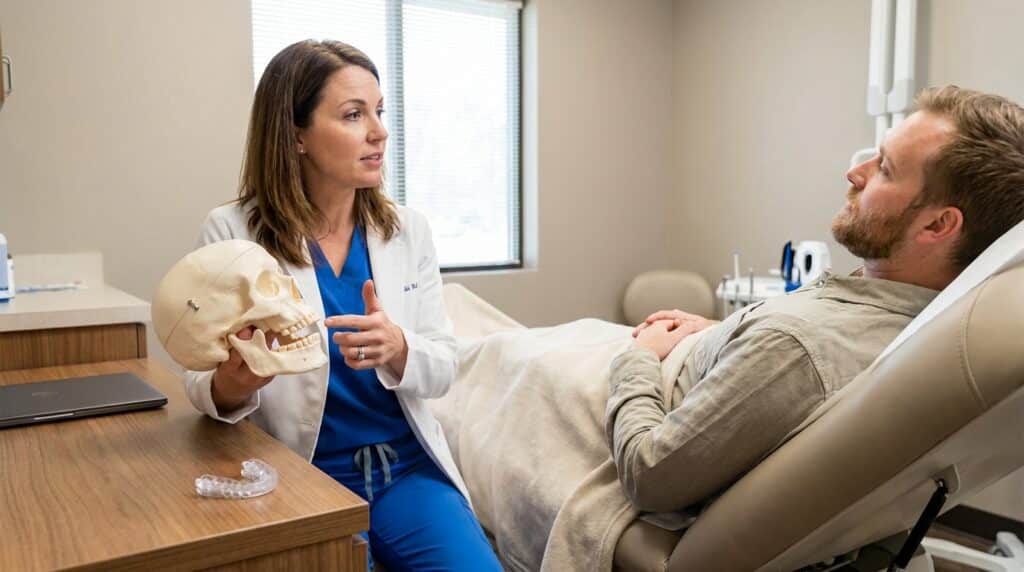
Dental evaluation is also important, ideally with a clinician experienced in TMD, for bite mechanics, night-guard fit, and occlusal contributors. These approaches are complementary. If you experience a jaw that locks open or closed, significant trauma, sudden bite change, facial numbness, or fever with jaw swelling, prompt medical or dental evaluation is important.
Thrive Health Acupuncture commonly collaborates with dental providers and specialists when appropriate, and many patients across East Setauket, Sayville, Smithtown, and Westhampton arrive with dental referrals already in place.
Frequently Asked Questions
Does acupuncture for TMJ hurt?
Acupuncture needles are very thin. Many people feel a brief pinch or pressure, followed by a dull, heavy, or warming sensation. Trigger-point work in the masseter can create a quick twitch and short-lived soreness that typically resolves within minutes.
How many sessions are usually needed?
Many patients do best with 6–10 sessions over 4–8 weeks. Newer cases may improve sooner, while long-standing or complex cases may require a longer plan and occasional maintenance.
Should I continue wearing my night guard during acupuncture?
Yes, if it has been prescribed and fitted appropriately. Research suggests the combination of an occlusal device and acupuncture for TMJ may outperform either approach used alone for some patients.
Can acupuncture stop clicking or locking?
In many myofascial-driven cases, acupuncture and dry needling can reduce clicking and improve range of motion. If the primary issue is internal joint derangement, imaging and dental/oral specialist input may be needed alongside acupuncture.
Is dry needling covered by insurance in New York?
Coverage varies by plan. Some policies include acupuncture benefits for musculoskeletal conditions, while others do not or apply limitations.
What can I do at home between visits?
Common supportive steps include softer foods during flare-ups, warm compresses over the masseter, gentle jaw range-of-motion drills (when appropriate), and improving awareness of daytime clenching, especially during computer work, driving, or stressful tasks.